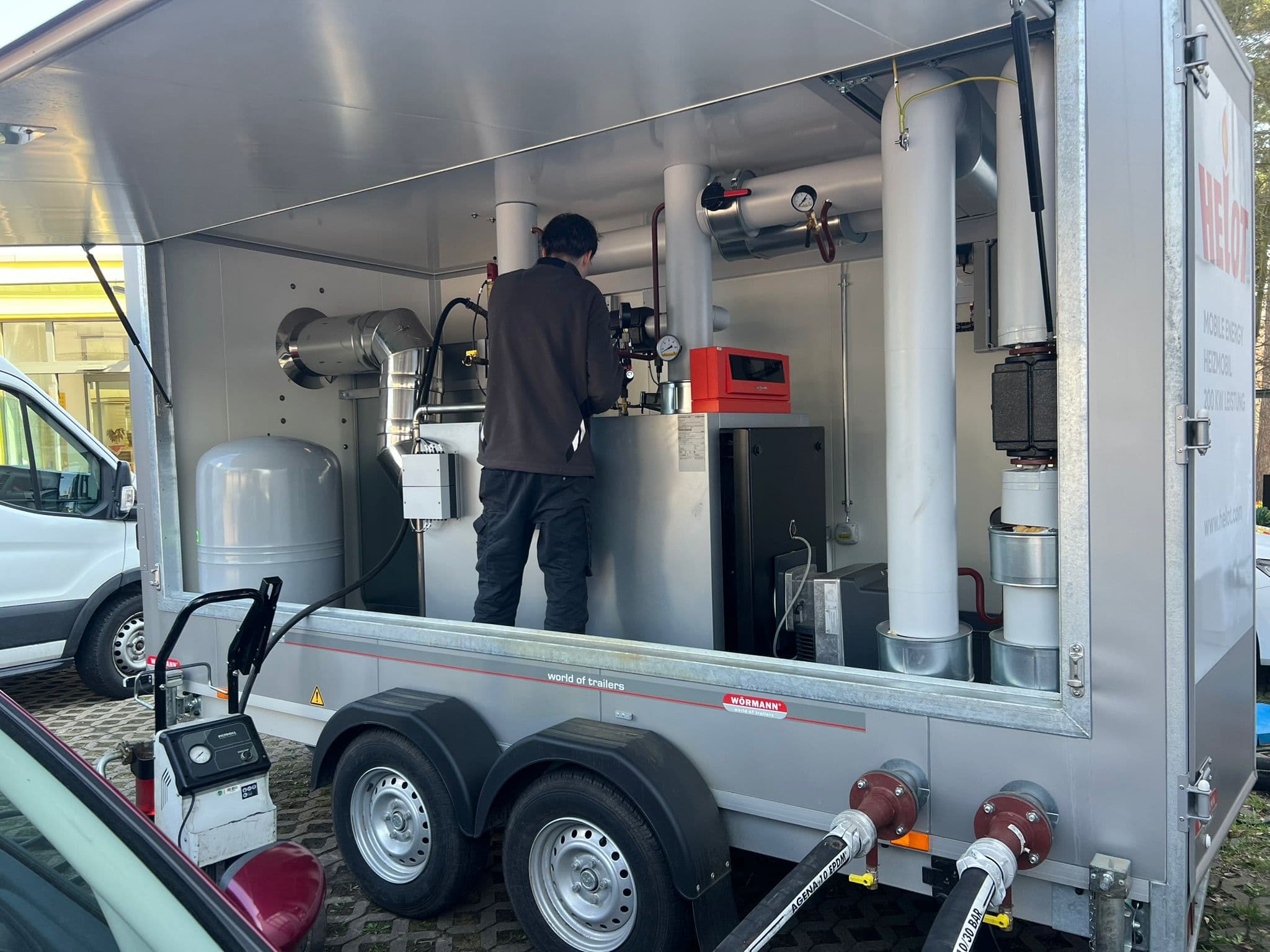
Heating trailer in action — inside view: burner, heat exchanger and pipe distribution
Table of Contents
- 1.Calculating heating capacity for event tents
- 2.Heating trailer vs. heating unit: direct comparison
- 3.CO safety: directly vs. indirectly fired
- 4.Condensation and moisture in the tent
- 5.Diesel, gas or electricity?
- 6.Booking notes
1. Calculating Heating Capacity for Event Tents
The heating capacity of an event tent in winter depends on outdoor temperature, tent size, tent insulation and occupancy. The basic formula is:
Heating formula for event tents:
Heating capacity (kW) = Tent area (m²) × heat loss coefficient
Standard marquee (canvas): 0.15 to 0.20 kW/m² at 0 °C outdoor temperature
Insulated industrial tent: 0.10 to 0.14 kW/m²
At –10 °C: multiply values by 1.4
Deduction per person: – 80 to 120 watts
| Tent size | 0 °C outdoors | –10 °C outdoors | Solution |
|---|---|---|---|
| 100 m² | 15 to 20 kW | 21 to 28 kW | 1 heating trailer 30 kW |
| 300 m² | 45 to 60 kW | 63 to 84 kW | 1 to 2 heating trailers 45 kW |
| 600 m² | 90 to 120 kW | 126 to 168 kW | Heating unit 120 to 160 kW |
| 1,500 m² | 225 to 300 kW | 315 to 420 kW | Multi-heating unit |
2. Heating Trailer vs. Heating Unit: Direct Comparison
| Feature | Heating trailer | Heating unit |
|---|---|---|
| Typical capacity | 20 to 90 kW | 60 to 500 kW |
| Suitable for | Tents up to ~600 m² | Large tents, halls from 500 m² |
| Setup time | 2 to 4 hours | 4 to 12 hours |
| Mobility | Towing vehicle sufficient | Truck, crane for large units |
| Heat distribution | Warm air via duct | Hot water (radiators/fans) |
| Uniformity | Good with 1 to 2 inlets | Very uniform |
| Fuel | Diesel (tank on trailer) | Diesel, gas or heating oil |
| Consumption (full load) | approx. 5 to 8 L/h at 45 kW | approx. 12 to 20 L/h at 120 kW |
3. CO Safety: Directly vs. Indirectly Fired
Safety notice: Never use directly fired equipment inside the tent
Directly fired heaters (e.g. construction heaters, open gas heaters) produce exhaust gas directly inside the room. In a closed tent, carbon monoxide (CO) can accumulate dangerously — invisible and odourless. As little as 200 ppm CO causes headaches; 1,600 ppm can be fatal within an hour.
Indirectly fired units Indirectly fired units (like all ATOWIK heaters) burn outside the tent: the exhaust stream is routed to the outside, only warm air enters the tent. Identifiable by a separate exhaust flue and the enclosed combustion chamber.
For events with more than 50 people, fire brigades and TÜV generally recommend the use of a CO detector as an additional safety measure, regardless of equipment type.
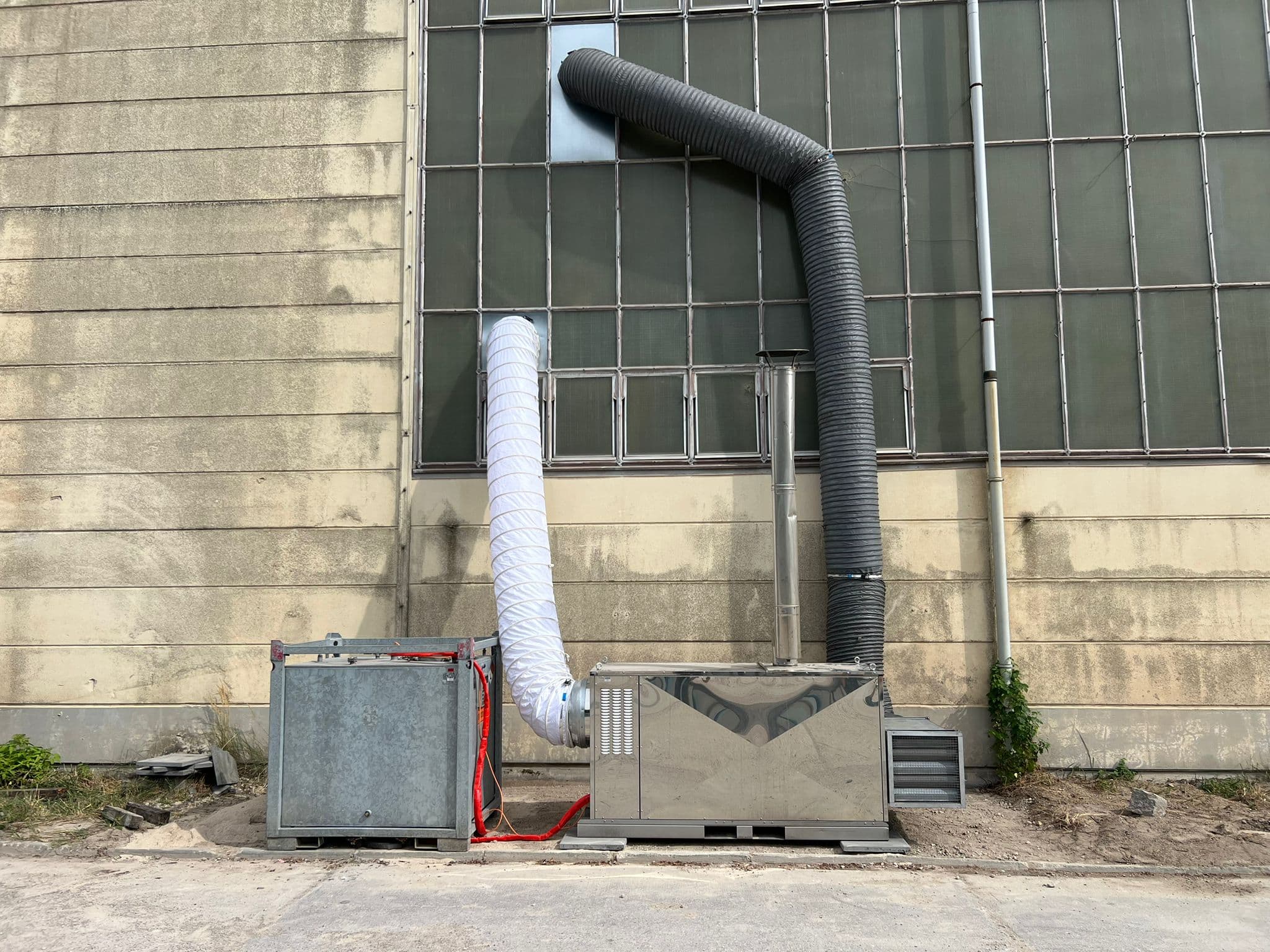
Indirectly fired monoblock heater — installed outside, warm air distributed via duct into the building
4. Condensation and Moisture in the Tent
A problem often underestimated at winter events: condensation. When warm, moist air (breath, perspiration from people) meets the cold tent skin, condensate forms and drips from the ceiling.
- Cause: 100 people emit approx. 5 to 8 litres of moisture per hour. With insufficient air circulation, this condenses on the tent canvas.
- Solution 1: Dehumidifier: Temporary sorption dehumidifiers (not refrigerant dehumidifiers, which do not work efficiently below 15 °C) keep relative humidity below 65 %.
- Solution 2: Positive pressure operation: Blowing in slightly more warm air than is extracted creates a slight positive pressure that prevents cold outside air from entering through openings.
- Solution 3: Roof heating: Targeted heat injection towards the tent ceiling keeps the surface warm and prevents condensation.
5. Diesel, Gas or Electricity?
Diesel
Advantages
Available everywhere, high energy density, no mains connection required
Limitations
Exhaust gases must be routed outside, odour during operation
Best application: Standard for mobile heating trailers and heating units
Natural gas / LPG
Advantages
Cleaner combustion, with natural gas: no fuel logistics
Limitations
Gas connection or gas cylinder bank required
Best application: Fixed exhibition venues with gas connection, halls
Electricity (heat pump)
Advantages
Quiet, no exhaust, can also cool
Limitations
High power demand (400 V / 63+ A per 30 kW), less efficient in cold
Best application: Combination solutions (cooling in summer, heating in winter)
6. Booking Notes
The factors that influence project costs for heating trailers and heating units include equipment size, rental duration, distance and season. Since every winter project has individual requirements, we provide quotes exclusively on request — a free quote is available the same day.
Always included in the price
- ✓ Delivery with own vehicle
- ✓ Assembly and commissioning by technician
- ✓ Operation during the event
- ✓ Dismantling and return transport