Table of Contents
- 1.Why tents are a special challenge
- 2.Calculating cooling capacity: the kW formula for event tents
- 3.Equipment types compared
- 4.Installation and assembly: what you need to know
- 5.Common planning mistakes
- 6.Booking recommendation
1. Why Event Tents Are a Special Challenge
Event tents — whether marquees, pagodas, stretch tents or arched halls — have physical properties that make them thermally far more demanding than solid buildings. The tent fabric absorbs solar radiation and transfers heat directly to the interior. Under direct sunlight, the indoor temperature of an unshaded tent can rise by 8 to 12 °C within 30 minutes.
Adding to this: people generate considerable heat. An adult at rest emits approximately 90 to 120 watts, rising to 300 watts during physical activity (dancing, sports). With 500 people in a tent, that alone accounts for 45 to 150 kW of human heat load, before lighting, equipment and catering are added.
This combination of solar load and high occupancy density makes professionally dimensioned temporary air conditioning virtually indispensable for event tents with around 100 people or more and temperatures above 22 °C.
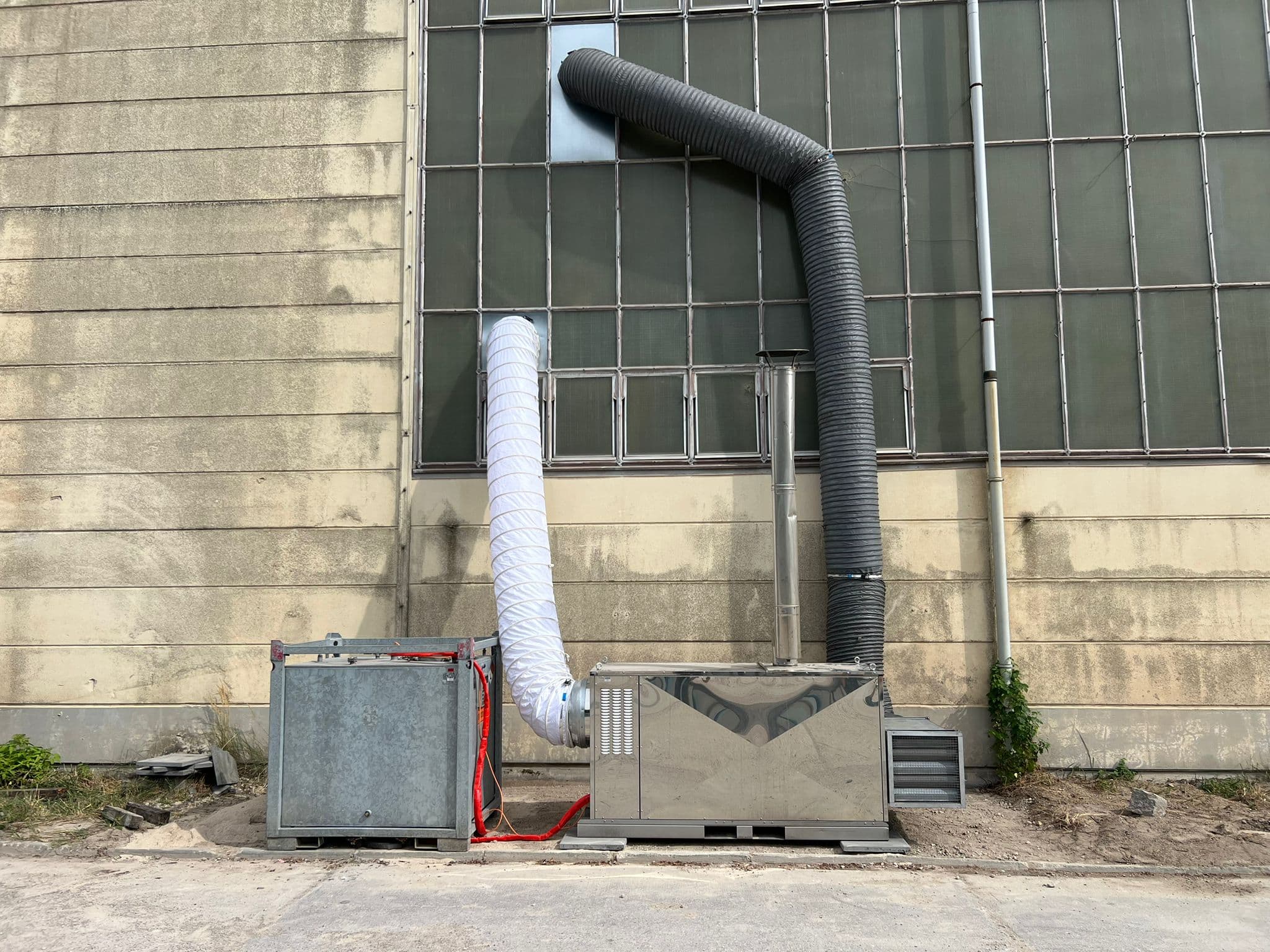
Mobile industrial air conditioning units are set up outside and route cold air via duct into the tent
2. Calculating Cooling Capacity: The kW Formula for Event Tents
The standard formula for sizing tent air conditioning is:
Basic formula:
Cooling capacity (kW) = Tent area (m²) × specific cooling value (kW/m²)
Standard event: 0,08 bis 0,12 kW/m²
Concert / high occupancy: 0,15 bis 0,20 kW/m²
With sun exposure (unshaded): +20 bis 30 %
| Tent size | Standard event | High occupancy | Typical solution |
|---|---|---|---|
| 50 to 100 m² | 4 to 12 kW | 8 to 20 kW | 1 to 2 split units |
| 100 to 250 m² | 8 to 30 kW | 15 to 50 kW | 2 to 4 industrial monoblocks |
| 250 to 500 m² | 20 to 60 kW | 38 to 100 kW | Chiller + Fancoils |
| 500 to 2,000 m² | 40 to 240 kW | 75 to 400 kW | Chiller system |
| 2,000 to 10,000 m² | 160 kW to 1.2 MW | 300 kW to 2 MW | Multi-chiller system |
These are guide values. Exact sizing depends on tent roof insulation, window/opening ratio, equipment heat load (lighting, PA system) and the desired indoor climate.
3. Equipment Types Compared
Mobile split air conditioners (5 to 14 kW)
Advantages
- Compact, quick to install
- Quiet operation (outdoor unit outside the tent)
- Low space requirement inside the tent
Limitations
- –Only for small tents up to approx. 150 m²
- –Multiple units needed for larger areas
Suitable for: Pagodas, lounge areas, VIP tents
Industrial air conditioning / Monoblock (12 to 60 kW)
Advantages
- Medium capacity without water network
- Freestanding, no fixed installation
- Operational within 1 to 2 hours
Limitations
- –Unit stands in or directly next to the tent
- –Louder than split units
- –Exhaust air must be routed
Suitable for: Medium marquees (150 to 400 m²), outdoor parties
Chiller + Fancoils (from 40 kW)
Advantages
- Unlimited scalability
- Uniform temperature distribution
- Quiet inside (chiller outside)
Limitations
- –Higher installation effort (water pipes)
- –Minimum lead time 48 hours
- –Power supply 63 to 400 A required
Suitable for: Large event tents (500 m²+), trade fair projects, multi-day events
4. Installation and Assembly: What You Need to Know
When planning tent air conditioning, the following technical requirements need to be clarified:
- Power connection: Split units require 230 V / 16 A per unit. Industrial monoblocks require 400 V / 32 to 63 A. Chiller systems from 500 kW require 400 V / 125 to 400 A. Coordination with the power supplier or generator operator is mandatory.
- Condensate drainage: Air conditioning units produce condensate water (approx. 1–3 litres per hour per 10 kW). For monoblock units, a drain or condensate tank must be planned.
- Air distribution: Cold air sinks. When blowing in from above or through side vents, uniform distribution must be ensured. Low air velocity (max. 0.3 m/s at person height) prevents draught complaints.
- Outdoor unit placement: For split and chiller systems, the heat-releasing unit stands outside the tent. Free air circulation (min. 1.5 m clearance from walls/tent fabric) is required. In afternoon sun: prefer placement in shade.
5. Common Planning Mistakes in Tent Air Conditioning
Mistake 1: Booking too late
In peak season (June–August), units from 40 kW are often reserved 3 to 6 weeks in advance. Enquiries two weeks before the event frequently find no capacity available.
Mistake 2: Calculating cooling capacity by area alone
The number of people and event type are just as decisive as the m² count. A concert with 300 people in 200 m² requires more than twice the capacity of a quiet conference with 100 people in 400 m².
Mistake 3: Ignoring the power situation
The most common installation stopper: there is no adequate power connection on site. This must be clarified in advance with the venue or generator operator without exception.
Mistake 4: Starting cooling too early
It is less efficient to cool an empty tent for hours than to start 30 to 60 minutes before guests arrive. Optimise tent planning in advance with cooling flaps or shading.
6. Booking Recommendation
The factors that influence the total project cost for temporary tent air conditioning include equipment rental, delivery, installation, operating days and dismantling. Since every project is individual — distance, duration, equipment type and specific requirements all vary — we provide quotes exclusively on request.
Free quote same day
Share the tent size, event date, location and approximate number of guests — we size the system and provide a concrete quote, no obligation.
+49 179 2215365